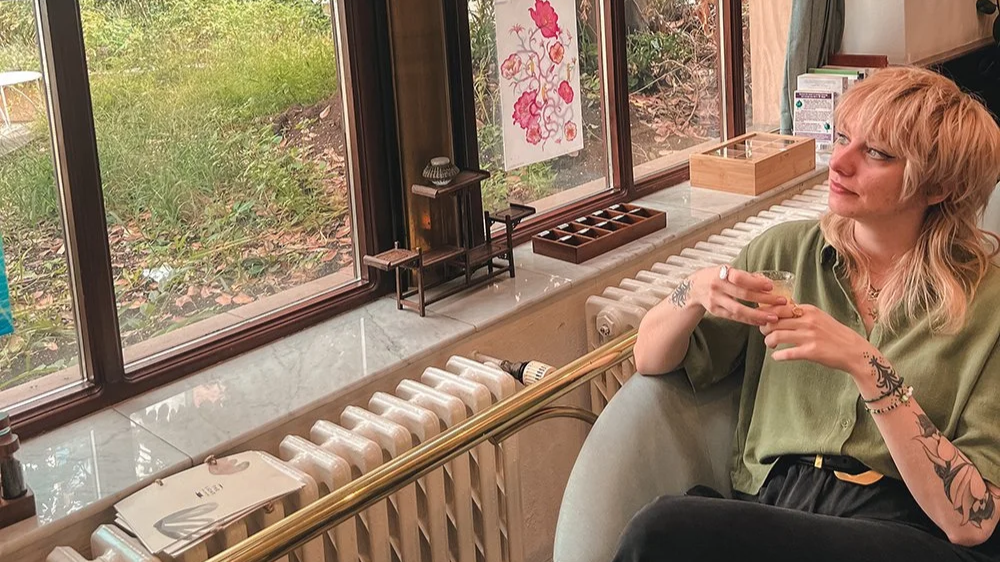
A Nightmare That Became Reality
Illustrator Martina Fischmeister developed a severe ear condition in which even the quietest sounds cause pain. Today, she hopes to raise awareness through her work.
Interview by Tereza Urban for Designnews.cz
Imagine that even the sound of your own breathing causes you pain. For illustrator Martina Fischmeister, this nightmare became reality. But hyperacusis did not defeat her. Step by step, she is finding her way back to a more normal life and dedicating her energy to raising awareness of this debilitating condition.
Can you tell me how your hyperacusis began?
MARTINA: It started in April 2023. I injured my neck, which worsened the tinnitus I had already been living with for eleven years. Shortly afterward, I also went to a concert at a bar. A few days later, my condition started to deteriorate. Personally, I believe it was a combination of those two events. I also think I may have a genetic predisposition.
How did your condition begin to worsen?
MARTINA: My tinnitus became so loud that even powerful sounds, like an approaching subway train, couldn’t mask it. I also started noticing that more and more everyday sounds were becoming unbearable. For example, announcements on public transport made me physically tense and uncomfortable. Gradually, it got worse, and even ordinary conversations with people became difficult to tolerate.
The main trigger that caused my condition to deteriorate further, however, was hyperbaric oxygen therapy. I don’t want to discourage anyone from trying it, because it helps many people. Unfortunately, in my case, it had the opposite effect. That’s when I started experiencing genuine physical pain.
HYPERACUSIS
Hyperacusis is a reduced tolerance to sound. Like tinnitus, hyperacusis is a symptom rather than a disease itself. Everyday sounds can seem much louder than they actually are and may cause pain.
The normal threshold for sound-induced pain is around 120–140 dB (for example, a rock concert or a gunshot). However, for people with painful hyperacusis, even gentle sounds such as their own breathing or speech can trigger pain.
The pain can be prolonged and unbearable.
EVEN BREATHING WAS EXCRUCIATING
How does hyperbaric oxygen therapy actually work?
MARTINA: It’s a pressurized chamber designed to increase the amount of oxygen your body absorbs. The chamber itself is quite loud, and it’s commonly prescribed for tinnitus. Unfortunately, it had the opposite effect on me.
The pain felt like burning and stabbing sensations deep inside my ears, accompanied by a dull ache that spread across my face, through my jaw, and into my back. I also developed migraines. Even someone speaking next to me was enough to trigger the pain. Over time, my condition continued to worsen.
Eventually, it reached the point where even breathing hurt. I spent an entire month lying in bed. I couldn’t move, everything was incredibly difficult. Gradually, though, I started to improve. I was able to move around the apartment again, but I still communicated exclusively through written notes.
My illness took over every aspect of my life. I moved back in with my family, who cared for me. I couldn’t work either.
How much does hyperacusis affect your everyday life and your work as an illustrator today?
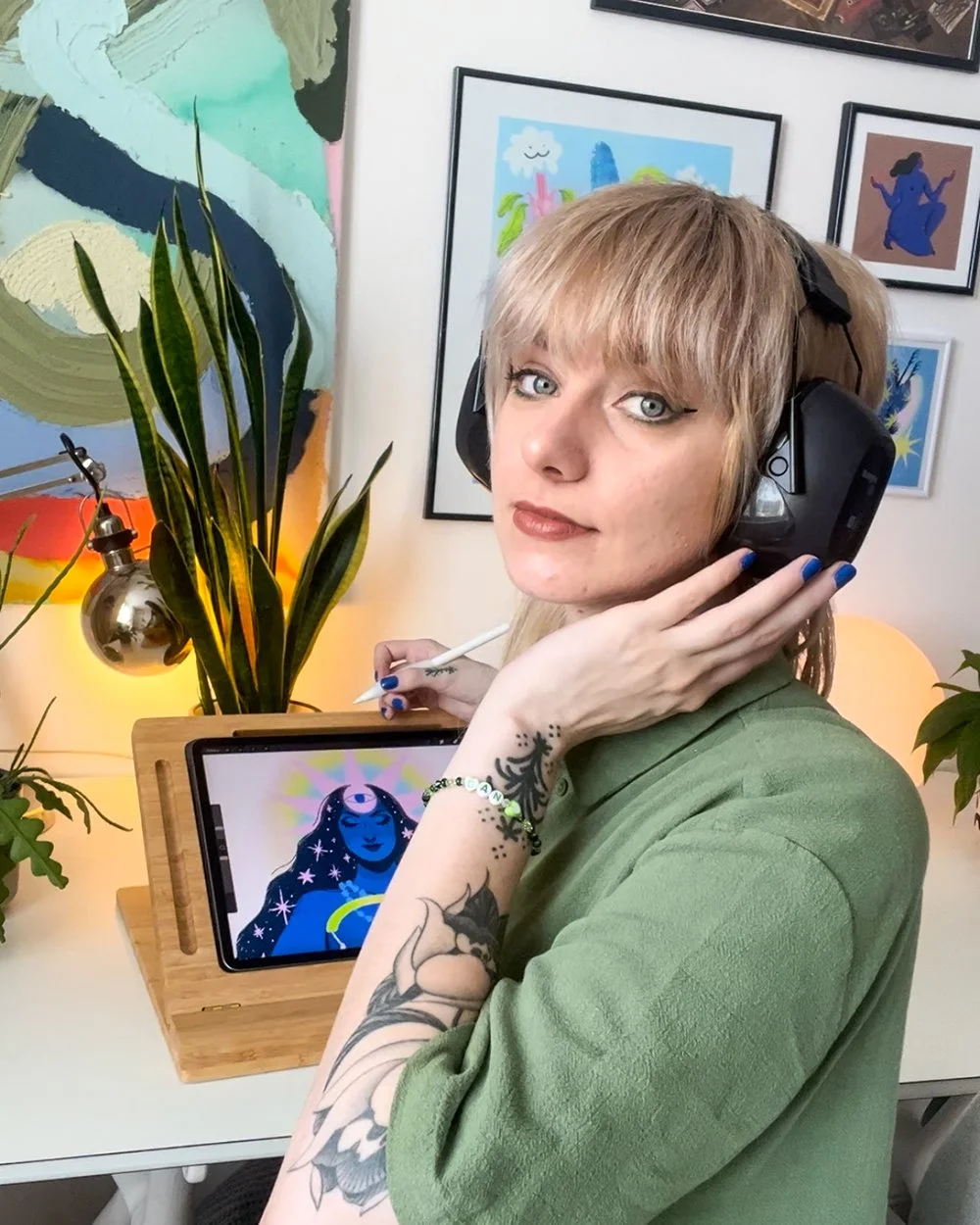
MARTINA: A great deal. I can now have a normal conversation and occasionally go outside, but I always need my specialised hearing protection - earmuffs and earplugs. I’m constantly careful. With hyperacusis, unfortunately, it only takes one sound beyond my tolerance for my condition to worsen again.
When did you receive your diagnosis?
MARTINA: I went to doctors as soon as I realized something was wrong. They performed all kinds of tests and referred me to various specialists. Unfortunately, I quickly discovered how difficult it is to find help for this condition. Many doctors didn’t even know what hyperacusis was. As a result, my appointments were mostly frustrating.
Several times I was told there was nothing more they could do for me and was referred to psychiatry, even though my condition is physical in nature. My medical records state that I have hyperacusis syndrome, but I never received a definitive diagnosis. That’s because hyperacusis is actually a symptom of an underlying form of auditory damage rather than a diagnosis in itself.
It wasn’t until I joined an online community of people living with hyperacusis that I finally started finding answers. I began to understand the condition, how serious it is, and how profoundly it affects people’s lives.
Accepting it was incredibly difficult. I felt as though my life was over. I was confused, frightened, and unwilling to accept that this was now my reality. At the same time, I was also coping with the end of an eleven-year relationship. I became depressed. It was an incredibly difficult period, and I’m deeply grateful that my family gave me the opportunity to stop working for a while. Looking back, I think I got through it only because of the support of the people around me.
RAISING AWARENESS
In your Instagram post, you also mentioned a nonprofit organization dedicated to hyperacusis research. How does it work?
MARTINA: It’s called Hyperacusis Research. As far as I know, it’s the only organization in the world dedicated exclusively to researching hyperacusis. They raise funds, which are then awarded to selected researchers to support their work.
There’s also Hyperacusis Central, which focuses mainly on raising awareness. They publish personal stories, practical advice, and educational information about the condition.
When you read other people’s stories, did any of them give you hope that your condition could improve over time?
MARTINA: I definitely believe improvement is possible. The problem is that the stories that don’t end well tend to be much more visible—and much louder. Still, I’ve learned valuable lessons from them. I would really love to see more positive stories being shared.
Did you find support within the artistic community, or did you encounter misunderstanding from colleagues or the public because of your illness?
MARTINA: Ever since I shared my story on social media, I’ve received an overwhelming amount of support, and I’m incredibly grateful for it. Honestly, I was surprised that people believed me, because this condition is so unusual. (laughs) They didn’t assume I was exaggerating or making it up, and that meant a lot to me.
That said, I still encounter some misunderstanding. I continue to receive invitations to events that I simply can’t attend. I know people mean well, but it’s also a reminder that many still don’t fully understand just how limiting this condition really is.
What made you decide to share your story publicly?
MARTINA: After a while, I started missing any connection with the outside world. I felt completely cut off. I was only seeing my family and a few close friends, and I wanted to reconnect with my own community again.
That’s when I started writing my Instagram post explaining what had happened to me. At the same time, I felt it was important to talk about this illness, raise awareness, and hopefully contribute to preventing others from going through the same experience.
What are some common misconceptions about tinnitus and hyperacusis that you’d like to correct?
MARTINA: One misconception about tinnitus is that it’s simply an annoying ringing in your ears. It can actually become unbelievably loud, so loud that it drowns out everything else. There are also many different types of tinnitus. Some people hear low-frequency sounds, while others hear a high-pitched ringing. Some even experience physical vibrations.
There’s also reactive tinnitus, which remains poorly understood by researchers. In those cases, masking the tinnitus with external sounds simply doesn’t work.
When it comes to hyperacusis, many people believe that protecting your hearing only makes the condition worse and that you simply need to get used to sound. In reality, even ordinary everyday sounds can make symptoms worse. It’s often said that sounds below 80 decibels can’t harm us, but unfortunately that’s not true for people whose auditory system has already been damaged. Pushing through pain and forcing yourself to tolerate sound often makes the condition worse and sometimes the worsening can be permanent.
The best advice I can give to people who know someone with hyperacusis is this: respect their limitations. Don’t pressure them into situations that seem “normal” to everyone else. Believe them when they tell you that something is painful and that they simply can’t do it.
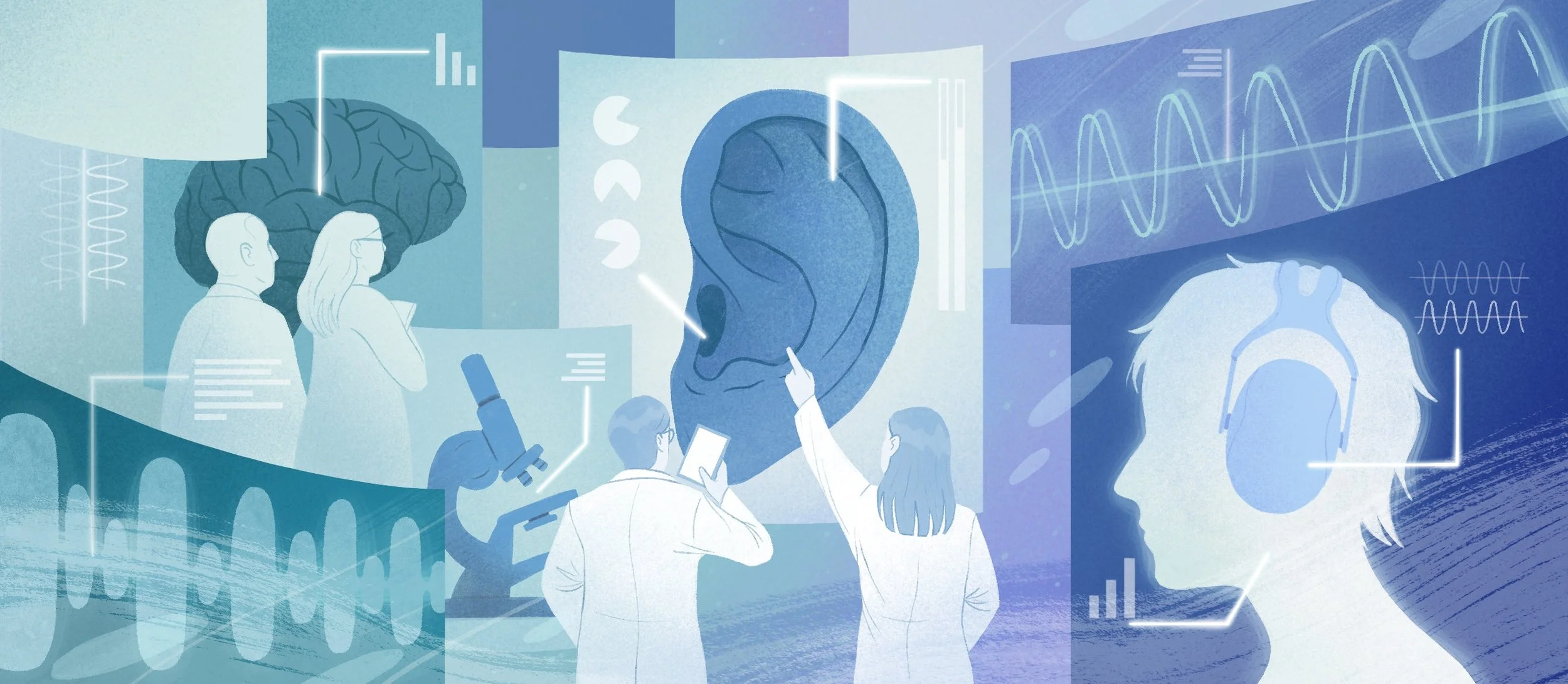
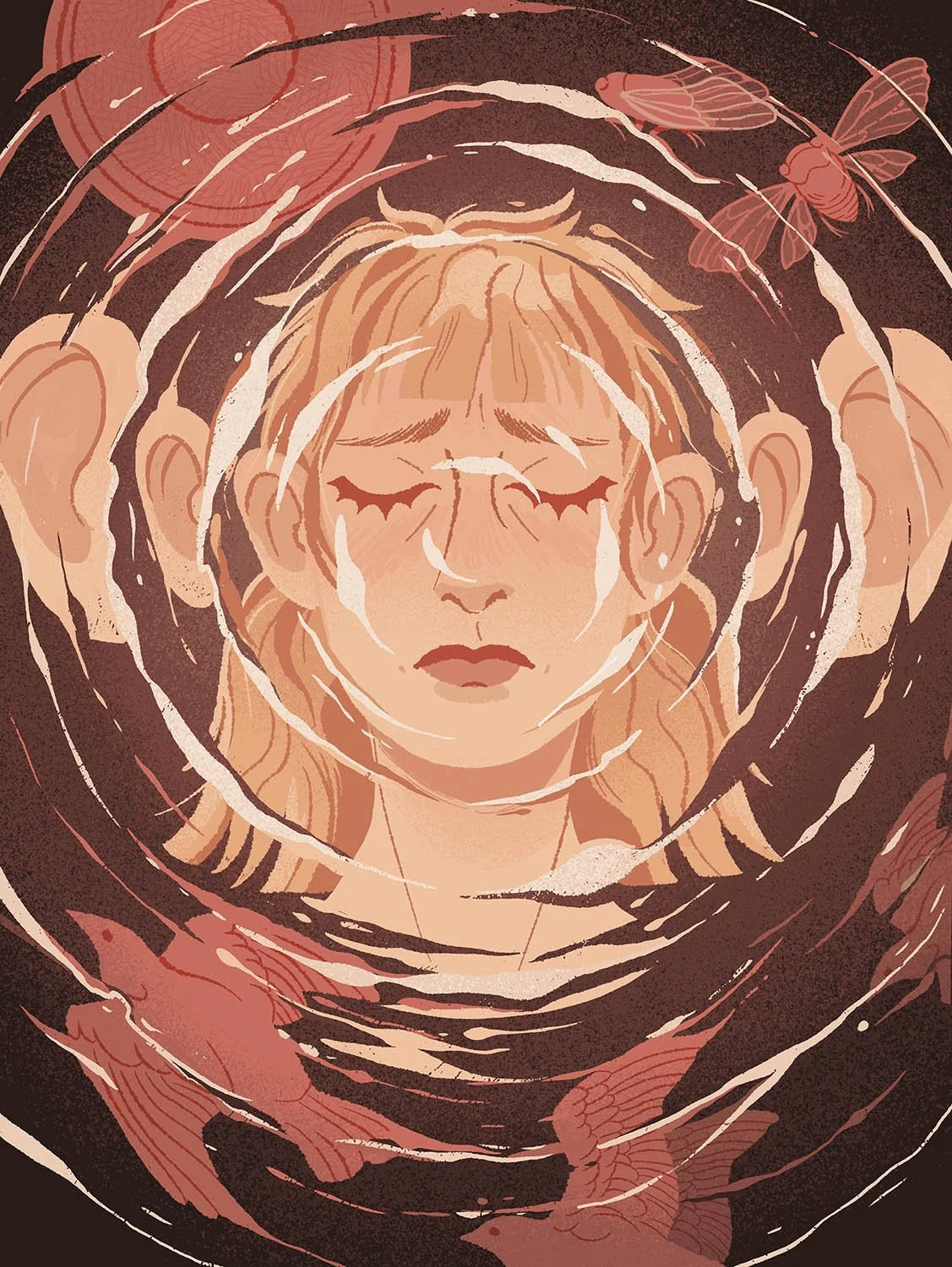
Illustration for organisation Hyperacusis Research
PAIN TRANSLATED INTO ILLUSTRATION
How has this illness affected the way you work, as well as your artistic style and the themes you explore in your illustrations?
MARTINA: There was a period of about four months when I couldn’t work at all. I tried sitting down at my computer to draw, but even the sound of the computer’s fan caused me pain despite wearing hearing protection. Eventually, I bought an iPad because it doesn’t produce any noise.
During that time, I accepted only one commission—an analog painting. The way I communicate with clients has changed as well. Before, communication was much more personal. Now we mostly communicate by email or over Zoom, where I rely on live captions.
As for my work itself, the biggest change came with switching to a different device. My style hasn’t changed dramatically, but I do feel it has become a little simpler.
I also wanted to address hyperacusis through my artwork, so I started collaborating with the organizations I mentioned earlier. I create illustrations for them, and that work feels deeply meaningful to me. Recently, I made an illustration about reactive tinnitus, a form of tinnitus that changes in response to sounds in the environment. Instead of remaining constant, it becomes louder whenever you hear an external sound. The piece was a self-portrait, which made it a very personal project. I’d like to create more illustrations like that, although I have to admit they can be emotionally draining.
Do you think it’s important for artists to engage in educational and awareness-raising projects like these? Do you feel Czech illustration is doing enough in this area?
MARTINA: I don’t think there can ever be too much awareness or engagement with topics like these. Visual art has a unique ability to communicate experiences in a way that resonates deeply with people.
I think of works like the graphic novel Bez vlasů (Hairless), about alopecia, Bezdětná (Childless), about coming to terms with infertility, or Naprostá šílenost (Absolute Madness), about anxiety. To me, these are all excellent examples of how illustration and comics can help people understand difficult experiences. That said, there’s always room for more.
I’d like to create a comic about hyperacusis myself, but I need to wait and see how my own journey unfolds. I want to be able to tell the whole story.
How did the system support you during that time? Would something like artist status or a universal basic income have made a difference? Given your experience, do you follow these discussions?
MARTINA: I definitely think something like that would have helped. I believe something similar can happen to anyone. We’re all just one unfortunate event away from becoming chronically ill or disabled. There should be a safety net for people whose lives change overnight.
Without my family’s support, I would have been in an incredibly difficult situation.
It’s hard for me to imagine receiving much support from the system because I don’t actually have an official diagnosis. It’s not even properly documented in my medical records. Some doctors didn’t take me seriously, so it’s difficult to imagine government offices taking me seriously either. The thought of having to fight my way through bureaucracy while I was in that condition is unimaginable.
What are you working on now besides raising awareness about hyperacusis?
MARTINA: I recently illustrated a book for Deník N called Animals in the Age of Humans. I absolutely loved working on it. For the first time in a long while, I felt like my old self again.
At the same time, I’ve realized that I can’t work at the same pace I used to. When you’re living with pain every day, it drains your energy, and you simply don’t have the capacity for everything else.
What brings you the most joy in such a difficult situation?
MARTINA: I’ve learned to appreciate the small things, even if that sounds like a cliché. I’m happy when I can make myself a cup of coffee, sit on the balcony, and watch the sky. I also enjoy being able to go outside again—slowly, and always with hearing protection.
Not long ago, I even went to an art exhibition for the first time. That experience stayed with me for weeks. (laughs) I’ve learned to appreciate the things I can do.
I’ve also found a partner who has the same condition. We met through the hyperacusis community. Having someone who understands you completely, someone who knows exactly what you’re talking about is incredible. I don’t have to explain anything to him because he already understands. There’s a level of connection between us that I don’t think I could have with someone who hasn’t lived through the same experience.